Measure a real stack, check drawer travel, and compare standard, box-bottom, and split-folder arrangements before buying a pack.
Quick answerMeasure the thickest part of the real packet as it will sit in the drawer. Choose a box-bottom folder when a group of papers needs a flat base and must stay together. Before buying a carton, test one proposed folder with its neighbors in place, then pull a middle document and close the drawer normally.
Why a flat bottom changes the fit
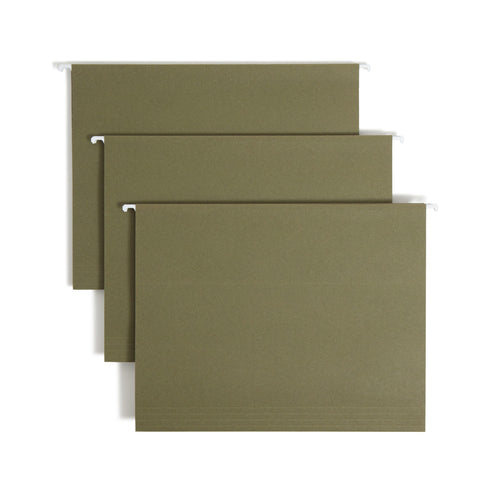
A standard hanging folder forms a narrow crease at its base. It works well for loose sheets and thin inner folders. A square booklet or a stack of manuals has a flat edge. In a narrow crease it can sit above the bottom, lean over, or push its tab into the cabinet roof. A box-bottom folder opens to a wider base, allowing the packet to sit lower and more evenly.
The expansion figure describes the folder’s base or expansion design. It does not guarantee that a particular quantity of paper will fit your drawer. Booklets have spines, portfolios have flaps, and a set of clipped invoices may be twice as thick at one corner. Load-bearing rails, room to spread nearby files, and clearance above the tabs all affect the result.
1. Measure the stack in filing order
Lay out the contents with the inner folders, booklets, and necessary fasteners in place. Stand or stack them naturally and measure the widest point without squeezing. Measure an offset corner separately if it bulges. Also measure the tallest item including its tab. Write down what makes the stack thick so you can decide whether changing the arrangement would solve the problem.
2. Pick the smallest sensible change
Try a standard folder if the packet settles evenly and individual pages lift cleanly. Try a flat-base folder when the bottom edge bridges a narrow crease. Split the contents when people routinely use different sections independently. A thick folder holding installation, billing, and new orders for several unrelated jobs is a candidate for splitting even if a wider product could contain it.
3. Test the intended expansion
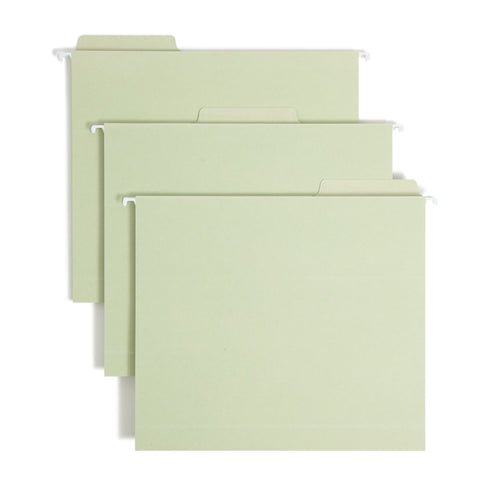
The Smead 64201 example below is a letter-size FasTab box-bottom folder with a nominal two-inch expansion and a built-in tab. Use a ruler to visualize a two-inch footprint along the rail run and allow room for adjacent files to move. If your stack already exceeds that measurement under ordinary handling, compare a larger suitable model or divide the material. Do not use the drawer front as a press to squeeze the papers in.
4. Check it through a full retrieval cycle
Hang the loaded folder in its real position. Slide the adjacent folder aside, read the tab, remove the most awkward booklet, and put it back. Close the drawer gently. Reopen it and look for curled corners, a shifted hook, or a neighboring folder falling into the space. If the hook span itself seems wrong, check the drawer’s rails and folder size before choosing a different expansion.
Three packets that need different treatment
| Sample packet | Practical choice |
|---|
| A dozen loose signed sheets used as one set | A standard hanging folder with a removable inner folder keeps the packet easy to lift. |
| A thick bound manual with service sheets | Test a flat base. Give the sheets their own inner folder so they do not catch on the spine. |
| A year of orders retrieved by quarter | Compare four thinner sections. Their labels may save more time than one wide container. |
Consider a packet measuring 1½ inches along its bottom edge with a clip that projects from its top corner. A two-inch base may support the paper, but the clip can still catch the next tab. Put the clipping point somewhere that stays clear or use a separate sleeve when the documents allow it. Pull the packet from the middle of the drawer during the test. A sample placed at the empty front can hide a crowding problem.
Make a buying decision you can repeat
Record the folder’s paper size, expansion, tab type, and the packet you tested. If the model uses a separate bottom insert, confirm it is present and follow its assembly directions. A built-in tab also changes your labeling supplies. Check its writable area before ordering clear plastic holders intended for slotted hanging folders.
If the contents grow faster than the room available, set a visible point for reviewing them, such as the moment the folder cannot open far enough to withdraw one booklet. Move genuinely closed projects into indexed boxes, or organize appliance paperwork by exact model if several machines have accumulated in a single packet. Buying a wider base is worthwhile when it solves the physical fit and preserves a usable filing order.

Comments
Comments are reviewed before they become public.
Sign in with Google to leave a comment.
Sign in with GoogleNo approved comments yet. Be the first to start the discussion.