How to Choose the Right Cordless Vacuum Cleaner
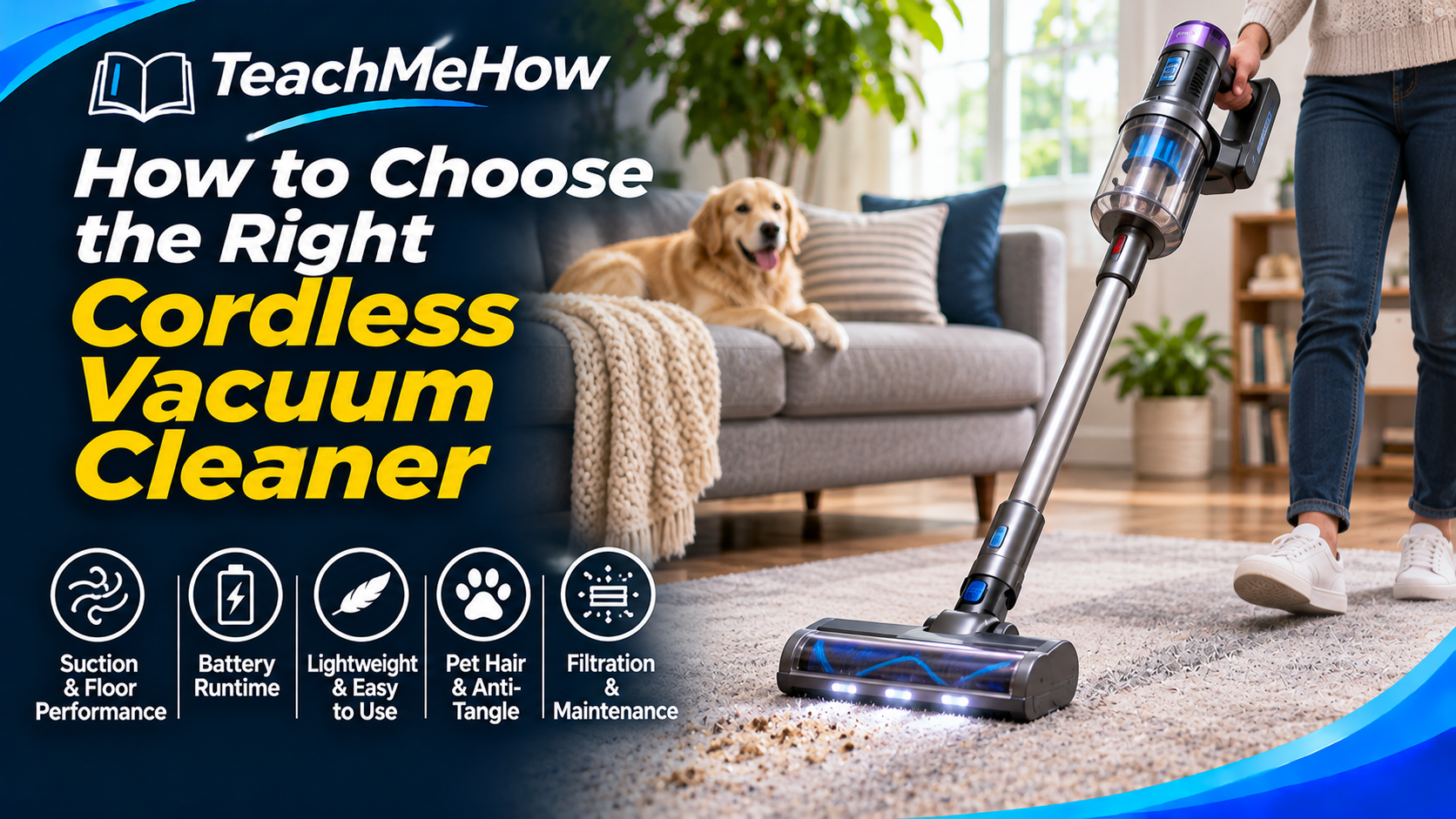
Learn how to choose the right cordless vacuum cleaner based on floor type, suction performance, battery runtime, filtration, weight, attachments, pet-hair cleaning, and maintenance costs.
Follow these steps at your own pace. Check product terms and prices directly with providers before purchasing.
How to Choose the Right Cordless Vacuum Cleaner
Cordless vacuum cleaners have changed considerably. A good modern model can handle hardwood, tile, area rugs, carpet, stairs, furniture, pet hair, and even car interiors without forcing you to move a power cord from outlet to outlet.
But the specifications can be confusing. Manufacturers advertise suction power, long battery runtimes, laser lights, automatic floor detection, filtration systems, anti-tangle brushes, and dozens of attachments. Some of those features are genuinely useful; others matter only for certain homes.
Quick answer: For most households, focus first on cleaning performance on your actual flooring, comfortable weight, realistic battery runtime, an easy-to-empty bin, and the cost of replacement batteries and filters. Those factors usually matter more than maximum suction numbers.
What Matters Most?
| Feature | Why it matters |
|---|---|
| Floor performance | The vacuum needs to work well on the carpet, rugs, hardwood, or tile you actually have. |
| Battery runtime | Determines whether you can finish your normal cleaning session without stopping. |
| Weight & balance | Affects comfort when cleaning stairs, furniture, and larger rooms. |
| Brush-roll design | Especially important for carpet, pet hair, and long human hair. |
| Filtration | Helps prevent fine dust from simply being blown back into the room. |
| Replacement parts | Batteries, filters, and brush rolls can significantly affect long-term ownership cost. |
1. Start With Your Flooring
The first thing to consider is not battery life or suction—it is the flooring in your home.
Mostly hardwood or tile
Hard floors need a cleaning head that can pick up fine dust as well as larger crumbs without pushing debris across the room. Soft-roller cleaning heads can work especially well because they make close contact with the floor while remaining gentle on the surface.
Mostly carpet
Carpet needs stronger agitation. A powered brush roll helps loosen dirt, hair, and debris trapped between carpet fibers before the vacuum pulls it into the bin.
A mixture of both
If your home has hardwood, rugs, and carpet, convenience becomes important. A vacuum that automatically adapts to different surfaces—or uses one effective all-purpose head—can save you from constantly changing attachments.
Buying tip: If more than half of your home is carpeted, prioritize the quality of the powered brush roll before paying extra for convenience features such as display screens or lights.
2. Do Not Buy by Suction Numbers Alone
Suction is important, but advertised numbers do not tell the entire story. Brands may describe suction using air watts, pascals, or other measurements that are difficult to compare directly.
Real cleaning performance also depends on airflow, seals, brush design, floor-head geometry, and how efficiently debris moves from the floor into the dust bin.
A vacuum with a huge advertised suction number can still perform poorly if its cleaning head does not make effective contact with the floor.
What to look for instead
- Independent carpet and hard-floor cleaning performance
- Good pickup along walls and edges
- Ability to handle both fine dust and larger debris
- Consistent suction as the bin begins to fill
- Strong brush-roll performance without excessive tangling
3. Battery Runtime: Read the Fine Print
Battery runtime is one of the most commonly misunderstood specifications on cordless vacuums.
A manufacturer may advertise 60 minutes of runtime, but that number is often measured at the lowest power setting and sometimes without a powered floor head attached.
Once you use stronger suction, motorized brushes, carpet mode, or maximum power, runtime can drop substantially.
Think in terms of your cleaning routine
| Home / Cleaning Style | What to prioritize |
|---|---|
| Small apartment | A single battery with moderate runtime is usually enough. |
| Medium home | Look for strong normal-mode runtime and efficient automatic power control. |
| Large home | A removable battery or second battery can be very valuable. |
| Quick daily cleaning | Maximum runtime matters less than low weight and easy storage. |
4. A Removable Battery Can Extend the Life of the Vacuum
A replaceable battery is useful for two reasons.
First, you can keep a second charged battery ready and continue cleaning when the first one runs out. Second, rechargeable batteries naturally lose capacity over time. If the battery can be replaced separately, you may not need to replace the entire vacuum several years later.
Before buying: Search for the price of a genuine replacement battery. On some premium vacuums, the replacement battery can be surprisingly expensive.
5. Weight and Balance Matter More Than They Look on Paper
A difference of a pound or two may not sound significant until you are holding the vacuum with one hand for 20 or 30 minutes.
Many cordless stick vacuums place the motor and battery near the handle. This makes the floor head easy to maneuver but can make the vacuum feel top-heavy when cleaning stairs, furniture, blinds, or shelves.
For everyday use, a slightly less powerful vacuum that feels comfortable may be a better choice than a heavier model with maximum specifications.
Pay special attention to weight if you:
- Have stairs
- Frequently clean furniture
- Use handheld mode often
- Have a large home
- Prefer quick daily cleaning rather than occasional deep cleaning
6. Pet Hair Changes What You Should Buy
Pet owners should look beyond basic suction.
Dog and cat hair can wrap around the brush roll, fill a small dust bin quickly, and become deeply embedded in carpet and upholstery.
For homes with pets, prioritize:
- Anti-tangle brush-roll design
- Strong carpet agitation
- Sealed filtration
- A reasonably large dust bin
- A powered upholstery or pet-hair attachment
- Easy brush-roll removal for cleaning
A miniature powered brush can be especially useful for sofas, stairs, pet beds, and vehicle seats.
7. Filtration Is About More Than the Word “HEPA”
Fine dust picked up from the floor should remain inside the vacuum. A good filtration system captures small particles before the exhaust air returns to the room.
HEPA filtration can be valuable, but the entire vacuum should also be reasonably well sealed. If air leaks around the filter, the filter itself cannot do its job effectively.
Check the filter maintenance too
Some filters are washable and reusable. Others must be replaced periodically. Washable filters can reduce ownership cost, but they need to dry completely before being placed back into the machine.
8. Dust-Bin Size Affects Everyday Convenience
Small bins help keep cordless vacuums lightweight, but they also fill faster.
For a small apartment with mostly hard flooring, this may not matter. For a larger carpeted home with pets, repeatedly stopping to empty the bin can become frustrating.
Look at how the bin empties as well as its capacity. A good design should allow you to release dirt into the trash without having to pull hair and debris out by hand.
9. Which Attachments Are Actually Useful?
A long list of accessories can make a vacuum look like a better value, but most people regularly use only a few of them.
| Attachment | Best use |
|---|---|
| Crevice tool | Edges, car seats, furniture gaps, baseboards |
| Dusting brush | Shelves, blinds, vents, delicate surfaces |
| Powered mini brush | Pet hair, sofas, stairs, mattresses |
| Soft floor roller | Hardwood, tile, fine dust, larger crumbs |
| Extension tool | High shelves, ceilings, difficult corners |
Choose the vacuum based on the accessories you will actually use rather than the total number included in the box.
10. Automatic Power Adjustment: Useful, but Not Essential
Some premium models detect the floor type or amount of dirt and automatically change suction power.
This can improve convenience and conserve battery. The vacuum may use lower power on an easy hard floor and automatically increase power when it reaches thicker carpet.
It is a useful feature, but it should not outweigh basic cleaning performance, comfort, or battery quality.
11. Headlights and Dust Illumination
Lights near the cleaning head can make fine dust surprisingly visible, particularly on dark hardwood floors or under furniture.
Some systems use angled illumination designed specifically to reveal particles.
This is one of those features that can seem unnecessary until you use it. However, it is still a convenience feature rather than a reason to overlook a vacuum that performs better in more important areas.
12. Storage and Charging
Think about where the vacuum will live when it is not being used.
Some models include a wall-mounted charging dock. Others use a freestanding dock, while simpler vacuums plug directly into a charger.
Wall dock
Great for saving floor space and keeping the vacuum charged, but requires installation.
Freestanding dock
Useful for renters or anyone who does not want to drill into the wall.
Direct charging
Simple and inexpensive, but the vacuum may need to lean against something during storage.
13. Can It Stand Up by Itself?
This is a small feature that becomes surprisingly noticeable during everyday use.
Many stick vacuums cannot stand upright without being returned to their dock or leaned against furniture. If you frequently pause while cleaning, a self-standing design can be convenient.
14. Maintenance Costs Matter
The purchase price is only part of what a cordless vacuum costs over its lifetime.
Depending on the model, you may eventually need:
- Replacement batteries
- Filters
- Brush rolls
- Cleaning heads
- Chargers
- Specialized attachments
Check whether these parts are sold separately before buying an expensive vacuum.
Which Type of Cordless Vacuum Is Best for You?
| If your home has... | Prioritize... |
|---|---|
| Mostly hardwood | Soft roller, lightweight design, fine-dust pickup |
| Mostly carpet | Strong powered brush roll and good battery capacity |
| Dogs or cats | Anti-tangle brush, large bin, filtration, pet tool |
| Multiple floors | Low weight and comfortable handheld use |
| Large floor area | Removable battery or dual-battery capability |
| Small apartment | Compact storage and easy daily use |
5 Common Buying Mistakes
- Believing the maximum runtime. Always check battery life using the powered floor head and normal cleaning modes.
- Choosing the strongest suction regardless of weight. A powerful vacuum you dislike carrying will not be enjoyable to use.
- Ignoring replacement-battery prices. Battery cost can significantly change the long-term value.
- Buying for attachments instead of cleaning performance. Ten accessories do not compensate for poor carpet or hard-floor pickup.
- Underestimating pet hair. Pet households benefit greatly from anti-tangle brushes and larger bins.
Before You Buy: Quick Checklist
- Does it clean your main floor type well?
- Is it comfortable enough to use for your normal cleaning session?
- Does the realistic battery runtime cover your home?
- Can the battery be replaced?
- Is the dust bin large enough?
- Does the brush roll resist hair tangles?
- Are the filters easy and affordable to replace?
- Are useful attachments included?
- Can you store and charge it conveniently?
- Are replacement parts readily available?
Bottom line: The best cordless vacuum is not necessarily the model with the biggest suction number or the longest list of features. For most people, the better choice is a vacuum that cleans their floors effectively, feels comfortable to use, lasts through a normal cleaning session, and can be maintained without expensive replacement parts.
Comments
Comments are reviewed before they become public.
Sign in with Google to leave a comment.
Sign in with GoogleNo approved comments yet. Be the first to start the discussion.