Compare travel jewelry boxes, folding organizers, and pouches. Learn how to keep chains apart, give earring posts room, and fit your largest piece before you buy.
Quick AnswerChoose a small structured case if you travel with rings, studs, or anything that needs space above it. A folding organizer works well for several fine necklaces if each chain has its own anchor and pocket. For one bracelet or a spare pair of earrings, a lined zip pouch may be all you need.
Compare Travel Jewelry Case Types
| Case type | Best for | Check before buying |
|---|
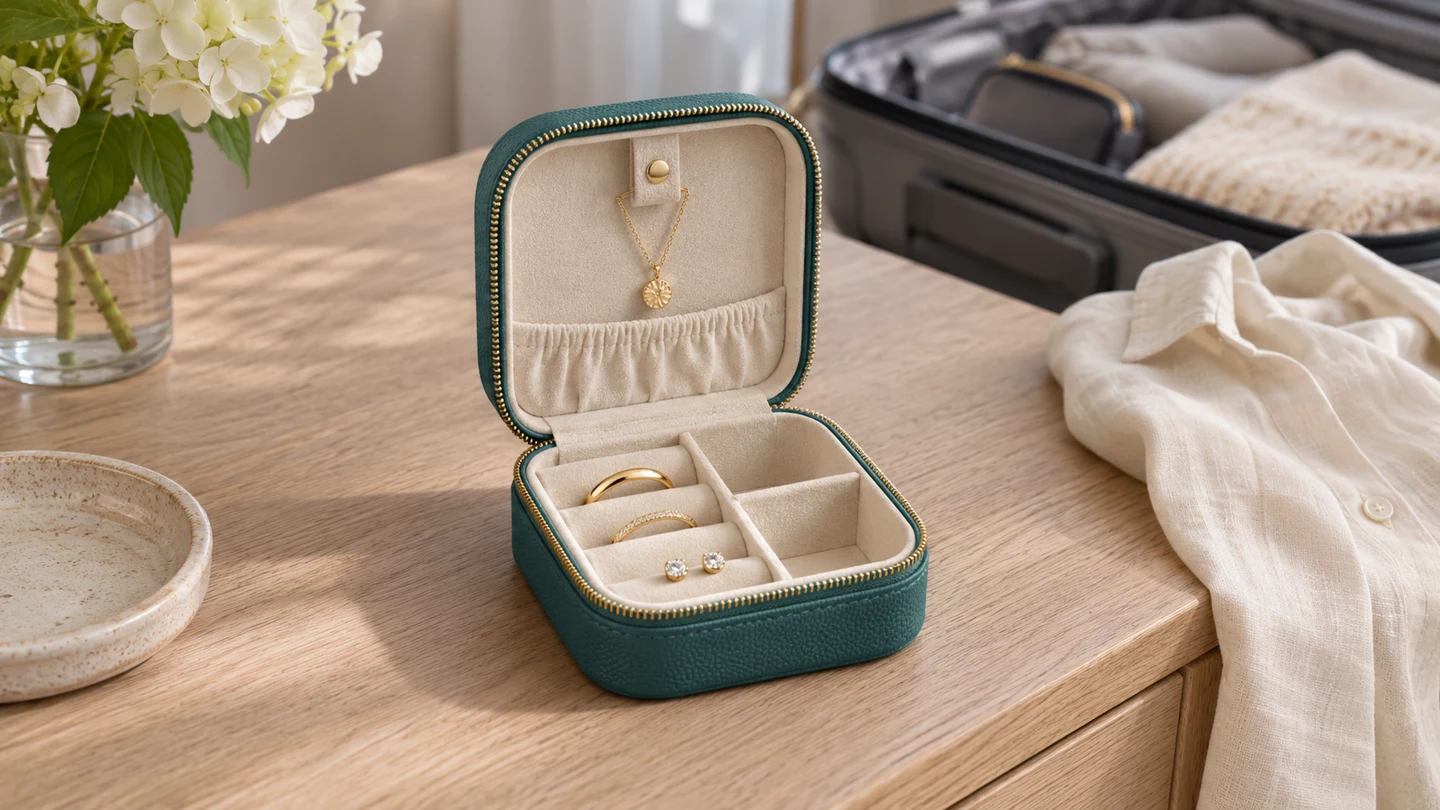
| Structured zip box | Rings with raised settings, studs, and small hoops | Space between the tallest piece and the closed lid |
| Folding organizer or roll | Several fine chains and flat pieces in a slim bag | Individual necklace anchors and somewhere to tuck each pendant |
| Lined zip pouch | A single bangle or one everyday set | A separate pocket if two pieces could rub together |
1. Start With the Pieces You Actually Pack
Lay out the jewelry you wore on your last trip. Count pairs of earrings and individual chains, then set aside the widest and tallest pieces. A box with six ring slots can still be too small for one cuff. Measure that cuff across its widest point and check the width of a single compartment. The outside width of the case includes the walls and zipper.
2. Follow a Necklace From Clasp to Pendant
Look at a photo of the case opened flat. Find the tab that holds a clasp, then trace where the pendant will sit. Two tabs over one large pocket keep the clasps apart, but the loose ends can still cross. If you pack several fine chains, look for divided pockets or give each necklace its own slim sleeve. Fasten each clasp before packing.
3. Allow Room Above and Behind Earrings
An earring panel needs clearance on both sides. The face of a stud sits on one side and the post and backing project from the other. On a folding case, check what the panel folds against. On a rigid box, check whether a mirror or divider closes directly onto raised stones. Keep spare backs in a zipped pocket you can open over a table.
4. Check How the Case Fits When Closed
A slim roll gains thickness once the pockets are full. A rigid box takes up the same space on every trip, but its shape gives delicate pieces more room. Measure the opening of the pocket where you plan to carry it. A case can fit inside a bag and still be awkward to pass through the opening.
Buying tipTrace the case’s published dimensions on paper and draw in the dividers from the product photo. Place your largest hoops or bangle on the outline. If they span two compartments, look for a removable divider or a wider pocket.
Match the Case to Your Trip
| What you’re packing | What to look for |
|---|
| A weekend set of studs and two rings | A compact box with ring rolls and an earring panel |
| Several necklaces for different outfits | A folding organizer with separate anchor points and pendant pockets |
| A statement cuff for an event | A deep compartment or dedicated lined pouch sized to the cuff |
| One spare pair of earrings in a day bag | A small zip pouch with a removable earring card |
Common Mistakes
- Counting holes as pairs. A panel with eight holes holds four pairs of studs. Large hoops can cover neighboring holes.
- Relying on a soft lining alone. Two pieces sharing an open compartment can still rub together when the bag moves.
- Filling every pocket before folding. Leave space at the hinge so the zipper closes without pressing on settings or bending posts.
Before You Buy: A Quick Checklist
- My largest piece fits inside one compartment.
- Each fine chain has its own place from clasp to pendant.
- Earring backs and raised rings have room when the case closes.
- I can fit the closed case through my bag’s pocket opening.
Bottom Line
Let your hardest-to-pack piece decide the format. Tall rings and studs favor a structured box. Several necklaces are easier to manage in a folding organizer with separate anchors. When you travel with just one piece, a small lined pouch leaves more room in your bag.


Comments
Comments are reviewed before they become public.
Sign in with Google to leave a comment.
Sign in with GoogleNo approved comments yet. Be the first to start the discussion.