How to Create a Proofreading Style Sheet for a Client Project
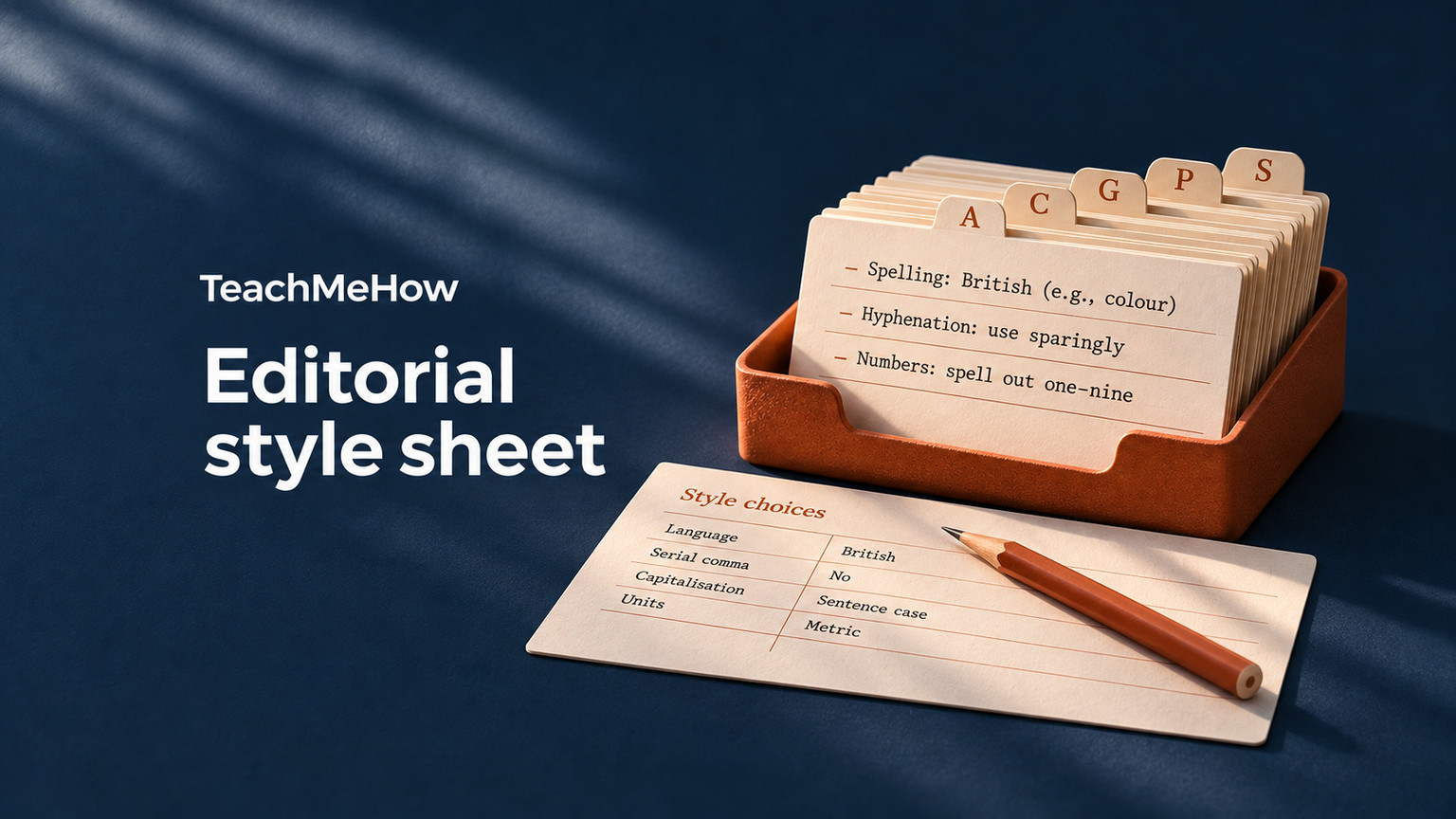
Build a project style sheet that records approved spellings, exceptions, and open questions. Includes a reusable table and a worked example.
Follow these steps at your own pace. Check product terms and prices directly with providers before purchasing.
Quick answer
Start with the client’s existing style sheet if they have one. For a new project, make a short table that records the approved form, an example of its use, and who or what supports the decision. Give unanswered questions a visible status so they do not turn into accidental rules.
Set the boundaries on page one
Identify the project, the draft or proof version, the English variety, and the reference the client wants you to follow. Ask how to handle conflicts between house style and official names. For example, a house preference for spelling out “and” may coexist with an ampersand in a sponsor’s registered display name. Keep a separate entry for that exception.
Starter style sheet for an event program
| Item | Form to use | Scope or example | Source / status |
|---|---|---|---|
| Venue | East Hall | Capitalize both words in headings and running text. | Client venue list · confirmed |
| Time | 6 p.m. | Use this pattern for times in running text. The supplied timetable uses 18:00. | Project brief · confirmed |
| Check-in | check-in desk / check in at the desk | Hyphenate the noun or adjective. Use two words for the verb. | Editorial decision · confirmed with client |
| Closing session title | Closing Forum or Closing Panel? | Heading and contents list disagree. | Query Q1 · awaiting organizer |
Add a decision when it saves a second search
Suppose “East hall” turns up on page 7. Check the venue list, add East Hall to the sheet, then search the proof for the other spelling. Inspect each occurrence in context. When an entry is already covered by the client’s reference, a short pointer may be enough. A sheet full of general dictionary entries makes project-specific decisions harder to find.
Keep unresolved facts visible
A time-format rule tells you how to present 6 p.m. It cannot tell you whether doors open at six or six-thirty. Send the client a short query with both locations and the choice you need. Once they answer, update the entry, mark it confirmed, and check every affected location, including captions or contents pages.
Hand off the version you actually used
Date the sheet, include the proof filename, and list any open query IDs with the person who can answer them. Share it with the marked file so the next reviewer can understand the exceptions. If the style table runs across printed pages, repeat the header row in Google Docs so each decision stays easy to interpret. In a live document, attach questions to the relevant text in Google Docs. In a typeset proof, anchor the correction on the PDF page. CIEP examples of project style sheets.
Comments
Comments are reviewed before they become public.
Sign in with Google to leave a comment.
Sign in with GoogleNo approved comments yet. Be the first to start the discussion.