How to Answer “What Is Your Greatest Weakness?” in a Job Interview
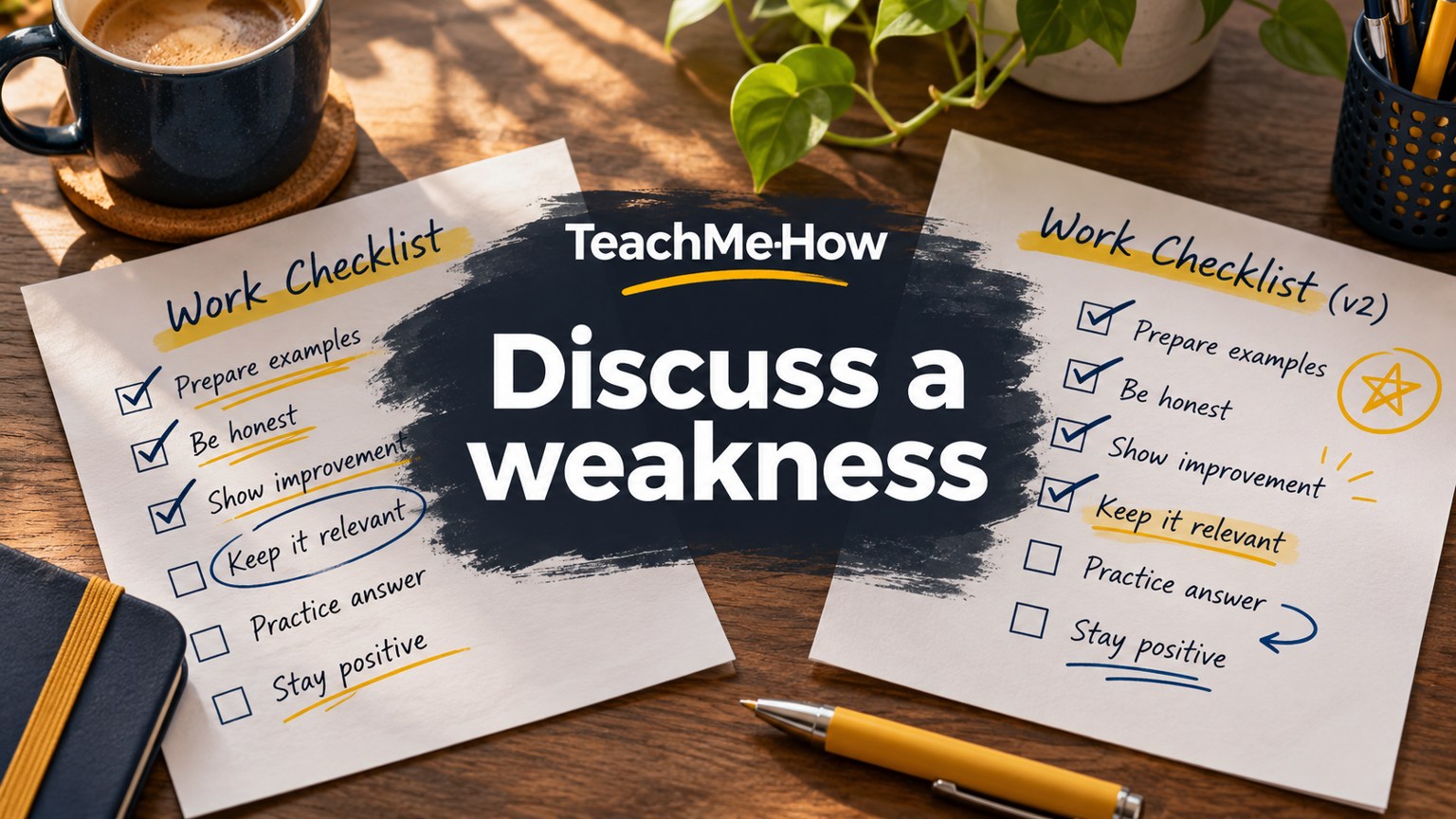
Choose a genuine weakness, describe its effect, and show how you manage it with examples drawn from everyday work.
Follow these steps at your own pace. Check product terms and prices directly with providers before purchasing.
Quick answer
Choose a work habit you are genuinely improving. Describe a situation where it caused difficulty, the change you made, and the evidence that the change helps. Be ready to say when the habit still takes conscious effort.
Find a weakness small enough to describe accurately
Think about the last piece of useful feedback you received. What did a colleague actually ask you to do differently? “Lead with the decision in your status emails” is easier to discuss than “be a better communicator.” You can remember the message, the reader, and how you changed the next update. Other useful starting points include estimating unfamiliar work or waiting too long to share a first draft.
Write down the cost to someone else. Did a teammate have to ask which version was final? Did your supervisor discover a dependency too late to move a deadline? A consequence keeps the answer grounded. Choose an example you can discuss openly and one for which you have already tried a remedy. A plan you hope to start next year gives the interviewer little evidence.
Build the answer around two comparable moments
Consider a candidate who used to send long project updates. Her first attempt is “I’m a perfectionist and sometimes give too much detail.” The word perfectionist suggests a compliment, and the listener still has no idea what went wrong. Compare that with an answer that describes the reader’s experience.
“I used to put the background at the top of weekly updates. On one rollout my manager read the email and still had to call to ask what I needed approved. I now open with the decision, who needs to make it, and the date. I put the supporting details below. On our next rollout the manager approved the change directly from the update. I still use that outline when I’m writing under pressure.”
The final sentence matters. It makes clear that the candidate has a dependable way to manage the weakness. If your evidence is less dramatic, describe something you can observe: your colleague found the revised file without help, a draft went out in time for review, or a handoff included the missing information. Use your own experience and leave out figures you cannot substantiate.
When the weakness touches an essential job duty
Read the posting again. If the role requires detailed written handoffs and yours have improved, take a recent example that demonstrates the level you can perform today. If you still cannot reliably do a required task, be accurate about your present ability. Explaining a training plan lets both sides discuss what support is available. Claiming mastery invites a difficult follow-up or a poor match.
For a first job, draw from a course, volunteer shift, or club. A student who divided a group project too late can explain how she now agrees on owners before the meeting ends. Give the context in one sentence so the interviewer can judge the example fairly.
Rehearse the follow-up that exposes a vague answer
Ask someone to interrupt with “When did it last happen?” or “How do you know the change worked?” A credible answer includes a recent occasion and a check you can still perform. If all you have is “I try harder,” work out the trigger, the action you take, and the sign it helped. Test the revision in a practice interview with specific feedback.
Sometimes the question is about one error rather than a recurring habit. For that version, explain how you corrected a particular mistake at work and what changed afterward.
Comments
Comments are reviewed before they become public.
Sign in with Google to leave a comment.
Sign in with GoogleNo approved comments yet. Be the first to start the discussion.