How to Choose the Right Christmas Gift Wrap Organizer
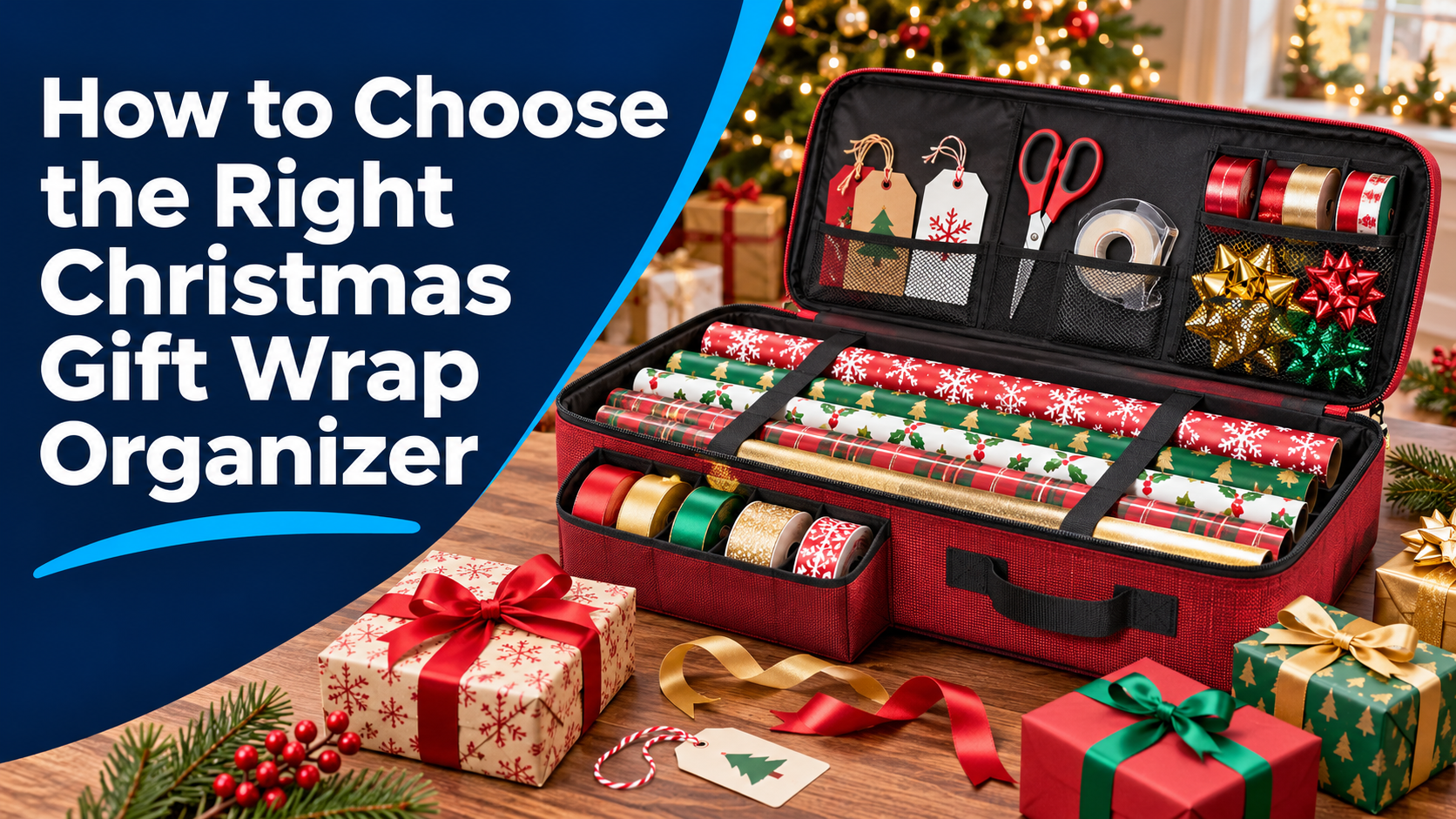
Learn how to choose the right Christmas gift wrap organizer based on storage capacity, roll length, ribbon compartments, portability, under-bed fit, hanging storage, durability, and seasonal organization.
Follow these steps at your own pace. Check product terms and prices directly with providers before purchasing.
How to Choose the Right Christmas Gift Wrap Organizer
Holiday gift wrapping has a way of spreading across closets, bedrooms, garages, and spare corners of the house. Rolls of paper get crushed, ribbons become tangled, gift tags disappear, and scissors somehow end up in a different room every time you need them.
A good gift wrap organizer keeps everything together and makes wrapping much easier from one Christmas season to the next. The best design depends on how much wrapping paper you own, where you plan to store it, and whether you also want space for gift bags, tissue paper, ribbon, bows, tape, and boxes.
Quick answer: For most households, the best gift wrap organizer is one that fits your longest rolls, has separate compartments for accessories, and can slide under a bed or fit neatly in a closet without crushing the paper.
What Matters Most?
| Feature | Why it matters |
|---|---|
| Roll length | Determines whether your wrapping paper actually fits without bending. |
| Capacity | Controls how many rolls, bags, and supplies you can store. |
| Compartments | Keeps bows, ribbon, tape, scissors, and tags from becoming mixed together. |
| Storage shape | Determines whether it fits under a bed, in a closet, or on a shelf. |
| Durability | Important if the organizer will be reused year after year. |
| Portability | Useful if you move wrapping supplies between rooms. |
1. Count What You Already Have
Before buying an organizer, gather your wrapping supplies in one place. Count your rolls of paper, gift bags, tissue paper, ribbon spools, bows, tags, tape, scissors, and boxes.
This helps you avoid buying an organizer that looks large online but becomes full after only a few rolls.
Buying tip: Leave some extra room for new wrapping paper you may buy during holiday sales or clearance after Christmas.
2. Measure Your Longest Wrapping-Paper Roll
Not all wrapping-paper rolls are the same length. Some organizers are designed for standard rolls, while others can accommodate extra-long paper.
If a roll is longer than the organizer, you may have to bend it or leave the zipper partially open, defeating the purpose of protected storage.
Measure before buying rather than relying only on a generic “gift wrap storage” description.
3. Under-Bed Organizers
Under-bed organizers are among the most practical designs because long wrapping-paper rolls fit naturally into a flat rectangular container.
They also make good use of storage space that may otherwise sit empty.
| Advantages | Tradeoffs |
|---|---|
| Large capacity | Requires sufficient clearance under the bed |
| Protects paper from crushing | Can become heavy when fully loaded |
| Easy to hide after the holidays | Accessories may shift unless compartments are included |
4. Hanging Gift Wrap Organizers
A hanging organizer attaches to a closet rod or door and stores wrapping supplies vertically.
This can be an excellent solution when floor space is limited.
Look for strong hanging hardware and enough structure so the organizer does not collapse when loaded with paper rolls.
5. Upright Storage Bags
Upright organizers hold paper rolls vertically in a closet, corner, or storage room.
They use relatively little floor space and allow you to see or remove individual rolls easily.
The downside is that they may not fit well beneath shelving, and lightweight models can tip if the weight is not distributed evenly.
6. Which Storage Style Is Best?
| Your storage space | Best style |
|---|---|
| Space under bed | Flat under-bed organizer |
| Small closet | Hanging organizer |
| Garage or storage room | Upright reinforced bag |
| Frequent wrapping | Portable organizer with handles |
| Large collection | High-capacity organizer with multiple compartments |
7. Separate Accessory Compartments Are Worth Having
An organizer that stores only paper rolls solves only half the problem.
Look for pockets or compartments for:
- Ribbon spools
- Bows
- Gift tags
- Tape
- Scissors
- Markers and pens
- Tissue paper
- Gift bags
Keeping these items together makes gift wrapping faster because you do not have to hunt for supplies in several locations.
8. Ribbon Storage Needs Special Attention
Ribbon spools can become tangled when stored loosely.
Some organizers include elastic straps or dedicated compartments that hold ribbon upright and prevent the spools from rolling around.
If you use a lot of decorative ribbon, this feature can be surprisingly useful.
9. Gift Bags Need Flat Storage
Gift bags are easy to crush if they are squeezed between heavy items.
Look for a flat pocket or separate section where bags can remain smooth and upright.
Larger reusable gift bags may need more space than standard wrapping supplies, so check the organizer dimensions carefully.
10. Tissue Paper Wrinkles Easily
Tissue paper works best when stored flat rather than rolled or folded tightly.
A large flat pocket can help keep sheets organized and reduce wrinkles.
If you regularly reuse tissue paper, having a separate section also makes it easier to sort by color.
11. Transparent Panels Make Finding Things Easier
A clear window allows you to see what is inside without opening the organizer.
This is particularly useful if you have separate containers for Christmas, birthdays, weddings, and other occasions.
If the organizer is not transparent, consider adding a label to the outside.
12. Fabric Quality Matters
Many gift wrap organizers use polyester or nonwoven fabric.
Lightweight fabric is fine for basic storage, but repeated use can put stress on seams, handles, and zippers.
If you have a large collection of wrapping supplies, look for reinforced stitching and heavier material.
13. Reinforced Sides Help Protect Rolls
Soft bags can collapse when objects are stacked on top of them.
Organizers with reinforced panels or structured sides provide better protection for delicate wrapping-paper rolls.
This is especially useful in closets or garages where other storage bins may be placed nearby.
14. Zipper Quality Is Easy to Overlook
A weak zipper can become the first part of the organizer to fail.
Look for a zipper that opens along enough of the container to make loading and unloading easy.
A small opening may force you to bend paper rolls just to get them inside.
15. Handles Make a Big Difference
If the organizer will be pulled from under a bed or carried between rooms, handles are worth having.
Reinforced handles are especially important when the organizer holds many paper rolls because the total weight can become substantial.
16. Consider Moisture Protection
Wrapping paper can absorb moisture and become warped, stained, or musty.
If you plan to store supplies in a garage, basement, or attic, choose an organizer that provides reasonable protection from dust and humidity.
Do not place paper storage directly against damp floors or walls.
17. Keep Holiday and Everyday Wrap Separate
If you have enough supplies, keeping Christmas wrapping separate from birthday and general-purpose wrapping can make organization much easier.
You will only need to retrieve the Christmas organizer once each year, while everyday wrapping supplies remain accessible.
18. Create a Complete Wrapping Kit
A well-organized storage bag can double as a portable wrapping station.
Keep basic tools inside permanently:
- One pair of scissors
- Clear tape
- Double-sided tape
- Gift tags
- Permanent marker
- Ribbon
- Bows
This prevents the common problem of borrowing household scissors or tape and forgetting to return them.
19. Think About Storage After Christmas
The organizer needs to fit somewhere for most of the year.
Before buying a very large model, measure your closet shelf, under-bed clearance, storage cabinet, or garage area.
Storage tip: A slightly smaller organizer that fits perfectly into your existing storage space can be more useful than a huge bag that has nowhere convenient to go.
20. Avoid Overfilling
Trying to force too many rolls into one organizer can crush the paper and strain the zipper.
If your collection continues growing, adding a second organizer may protect your supplies better than packing everything tightly into one.
Which Gift Wrap Organizer Is Best for You?
| Your situation | Prioritize |
|---|---|
| Small apartment | Under-bed or hanging storage |
| Lots of wrapping paper | Large roll capacity and reinforced structure |
| Lots of accessories | Multiple pockets and compartments |
| Garage storage | Dust and moisture protection |
| Frequent wrapping | Portable handles and easy access |
| Multiple holidays | Clear windows or external labels |
5 Common Gift Wrap Storage Mistakes
- Buying before measuring your rolls. Extra-long wrapping paper may not fit.
- Ignoring accessories. Paper storage alone does not solve ribbon, bow, tape, and tag clutter.
- Overfilling the organizer. This can crush the paper and damage the zipper.
- Choosing the wrong storage shape. A great organizer is useless if it will not fit under your bed or inside your closet.
- Storing paper in damp areas. Moisture can ruin wrapping supplies before the next holiday season.
Before You Buy: Holiday Gift Wrap Checklist
- How many paper rolls do you have?
- What is your longest roll?
- Do you need space for gift bags?
- Do you need flat tissue-paper storage?
- Are ribbon compartments included?
- Is there a place for scissors and tape?
- Will it fit under your bed or in your closet?
- Are the sides reinforced?
- Does the zipper open wide enough?
- Are the handles reinforced?
- Can you see the contents easily?
- Will it protect supplies from dust?
- Is the storage area dry?
- Can it hold a little more than your current collection?
Bottom line: The best Christmas gift wrap organizer should keep paper rolls straight, accessories separated, and your entire wrapping kit easy to find each holiday season. For most households, a structured under-bed organizer with accessory pockets and reinforced handles offers the best balance of capacity, convenience, and easy storage.
Comments
Comments are reviewed before they become public.
Sign in with Google to leave a comment.
Sign in with GoogleNo approved comments yet. Be the first to start the discussion.